Sunday, 31 May 2015

EUR/USD Faces Week Flush with Event-Driven Volatility

By Christopher Vecchio, Currency Strategist
EUR/USD Faces Week Flush with Event-Driven Volatility

Fundamental Forecast for Euro:Neutral
 
- EURUSD appears to have made a significant turn on the charts…
- …and recent gains seen in EURUSD may be setting up a ‘sell the rally’ opportunity.
- Have a bullish (or bearish) bias on the Euro, but don’t know which pair to use? Use a Euro currency basket.
 
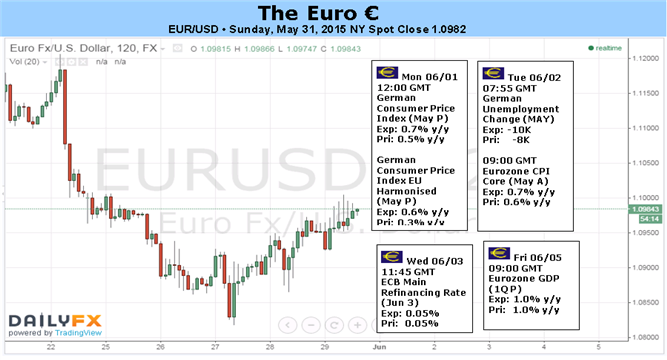
While EURUSD was pressured into fresh monthly lows just above $1.0800, a late-week rally in the EUR-crosses wiped out nearly all losses accumulated earlier across the spectrum. Dodging disparaging headlines about Greece’s ability to reach consensus with her creditors, EURUSD only closed -0.10% lower at $1.0990, while EURAUD and EURJPY led the EUR-crosses higher by +2.22% and +2.02%, respectively. 
 
The Euro’s sensitivity to the situation in Greece is bound to jump in the coming days, even if only temporarily, as a June 5 deadline for a payment to the IMF looms. This is a delicate situation insofar as the Greece government is purportedly open to defaulting on her obligations in order to maintain its political party’s pre-election promises. As far as the impact of the intraday headlines on the Euro, the likelihood remains low; but the ever so important tail risk scenario is becoming more probable, likely to leave traders a bit uneasy.
 
Of course, in the background, the ECB’s QE-driven trade – via the portfolio rebalancing channel effect – is dictating asset performances across the risk spectrum. In tandem, European sovereign yields are falling, the Euro is depreciating, and European equity markets are rallying (or vice-versa). This trilateral relationship should continue to persists, irrespective of the Euro’s direction.
 
In the very near-term, there is heightened risk to the Euro (and more specifically, EURUSD) as a calendar packed with medium- and high-ranked event risk is on the horizon. Event-driven volatility – particularly between the hours of 08:30 GMT to 14:00 GMT – will be well-represented this coming week.
 
On Monday, the German Consumer Price Index for May and the May US ISM Manufacturing survey are due. On Tuesday, May German labor market data and the May Euro-Zone CPI will be released, as well as US Factory Orders for April. On Wednesday, the ECB will hold its June interest rate meeting and press conference, while the May US ADP Employment Change report, the May US ISM Services gauge, and the Fed’s Beige Book will be released. On Thursday, the May PMI readings for the Euro-Zone and Germany, and the weekly US jobless claims data will be released. Lastly, on Friday, Q1’15 Euro-Zone GDP data will be released, while the May US Nonfarm Payrolls report and unemployment rate wil be due.
 
Needless to say, there are items on the calendar over the next few days on both sides of the pond that are likely to increase volatility around EURUSD. Besides previously discussed influences lingering in the background – Greece and the ECB’s QE program – the one theme that will be put to the test this week, that could drive the direction of EURUSD for the coming weeks, will be the notion that the US economy has reversed its early-year slowdown. Only if the recent optimism over the US growth story in Q2’15 is confirmed by the upcoming data, will the rising interest rate differentials in favor of the US Dollar story take hold. By the end of the week, we should have a better idea of which way EURUSD will be trading for the foreseeable future. –CV


France's Macron does not rule out eventual EU treaty change -report

 
PARIS, May 31 (Reuters) - French Economy Minister Emmanuel Macron wants a two-speed Europe and sees a possible change to European Union treaties in due time, he told newspaper Le Journal du Dimanche in comments published on Sunday.

"We have to accept the idea that Europe will be made on a two-speed basis, with a union based on solidarity and differentiation," Macron was reported as saying.

"The 28-member Europe must be simpler, clearer; more efficient and continue to advance on digital and energy issues," the economy minister said.

"As to the euro zone avant-garde, it must go towards more solidarity and integration: a common budget, a common borrowing capability and fiscal convergence," he added.

The 37-year old minister's comments come days after Germany and France agreed plans to strengthen cooperation among euro zone countries without changing existing EU treaties, in a potential setback for British Prime Minister David Cameron.

The blueprint would bolster the 19-nation euro zone, of which Britain is not a member, by holding more regular summits of its leaders, strengthening the Eurogroup forum of finance ministers and establishing euro zone-specific structures within the European Parliament.

On treaty change, which has been advocated by David Cameron as he toured European capitals this week but had been ruled out by France so far, Macron said:

"What's important is the project," adding that he was not speaking in the name of the government and that only President Hollande could speak for France.

"Treaty change is a method that would ensue and that we have to prepare in due time. If we ask the questions today to the people, the answer will be no. We have to reconcile Europeans with Europe," Macron, a former advisor to Hollande, added.

Le Journal du Dimanche said Macron and his German counterpart Sigmar Gabriel were working on joint proposals that they would make public later this week. (Reporting by Michel Rose)


Europe is in the recovery position, but it’s still unwell


It is not widely enough recognised that the UK is the eurozone’s largest single export market’, writes Roger Bootle

During the past few years it has been usual for both investors and commentators to assume that the eurozone is mired in depression, with little or no prospect of escape. But is this still true?

Not according to the gross domestic product (GDP) figures for the first quarter of the year. As I have noted before, Q1 was notably weak in several parts of the world, including the UK, China and most of the emerging markets. According to figures released on Friday, the US economy even contracted. By contrast, the eurozone registered quarterly growth of 0.4pc. It was particularly noteworthy that France managed to grow by 0.6pc, double our disappointing 0.3pc rate. 

In fact, some sort of recovery in the eurozone this year should not be so surprising. It has four things going for it. First (Other OTC: FSTC - news) , along with most of the developed world, it has benefited from lower oil prices, which have reduced costs and put money in consumers’ pockets. Moreover, unlike some other parts of the world, especially the US, the expansionary effects from lower oil prices have not been significantly offset in the short run by the hit to the domestic energy-producing sector. The countries of the eurozone produce virtually no oil or gas.

Second, the eurozone has been able to benefit from last year’s recovery in the US and the UK. It is not widely enough recognised that, as well as the eurozone being the UK’s single largest export market, it returns the favour. That’s right: we are the eurozone’s largest single export market. So the recovery here has also boosted the eurozone’s recovery through higher exports (that is, our imports).
Third, after the launch of quantitative easing (QE) in March, there has been a massive injection of liquidity €60bn per month, and set to continue at that level until September next year. Even if this achieves nothing directly, bearing in mind all the hype, it should at least help to boost confidence. 

Fourth, partially linked to the launch of QE but also connected with other factors, there has been a sharp drop in the euro exchange rate. Over the past year, on a trade-weighted basis it has fallen by about 12pc. Against the pound, it is standing close to a seven-and-a-half-year low. So some of the eurozone’s recent comparative economic strength has been due to its taking market share from other countries, including our own.

But is the eurozone likely to build on this recent recovery? I doubt it. Actually, more up-to-date information from April and May has already started to suggest a bit of a slowdown from Q1’s reasonable growth. According to the surveys, business and consumer confidence have dropped back a bit. That would not be surprising. Across the euro area, wage increases remain very low. Once the one-off boost to real incomes caused by lower oil prices has passed through the system, the rate of growth of real earnings should fall back. And, outside Germany and a few other northern core countries, the rate of unemployment remains appallingly high. 

It seems clear that QE will continue for a good while yet and this will be helpful at the margin. But just as I always doubted that QE was a transformative influence in the US and the UK, so I doubt its power in the eurozone. Insofar as it has caused the exchange rate to drop, it has boosted demand. But I doubt that it can do much more.

And whether the boost from the exchange rate will endure is anyone’s guess. Currencies have a habit of bouncing around unpredictably. Surely the euro is at or very near its limit against the pound? And you have to wonder whether the dollar has become too strong for its own good. A 10pc rise of the euro would do a good deal of damage to the eurozone’s export performance. This could happen as an indirect result of dollar/pound weakness, perhaps tied to a revision of the markets’ views on interest-rate prospects. Alternatively, it might happen as the result of some new development in the EU’s continuing identity crisis perhaps connected with the UK’s impending referendum. 

The fundamental problems of the eurozone remain essentially unaltered. The countries of the southern periphery are still caught in a trap of the euro’s making. Uncompetitiveness, fiscal austerity and high unemployment combine to produce anaemic growth at best. True, Germany and the Netherlands continue to do fairly well. But they also continue not to spend their full whack. The result is that Germany runs a current account surplus of 7.5pc of GDP, with the equivalent figure for the Netherlands being more than 10pc.

Meanwhile, the running sore that is Greece drains confidence. At some stage pretty soon, there is going to be a Greek “event”. Whether it takes the form of an outright default hardly matters. Actually, given that the players involved are Greece and the EU, whatever happens is unlikely to be straightforward. Even if Greece does not make its next payment to the IMF, which has widely been described as a default, in fact this is likely to be classified as a “missed payment”. Greece would have a period of some months before this became classified as a default good and proper. 

It is one thing to be in the dark about whether Greece is going to default and leave the euro, but it is deliciously ironic that, even after the event, we may not know for some time whether Greece has “defaulted” or not. 

Of course, anxiety about the Greek financial situation is holding back the Greek economy. Indeed, despite the eurozone’s pick-up in Q1, the Greek economy actually contracted. But across Europe the Greek situation is having an effect as people watch and wonder about the stability of the euro, the robustness of the banks and their own financial security. Perhaps this is the reason for the softening of confidence across the eurozone revealed in the April and May surveys. 

The upshot is that in 2015 the eurozone should register its best performance for several years. It should grow by about 1.5pc. But don’t be fooled into thinking that this means the eurozone’s economic crisis is over. Growth could easily fall back next year. Only when southern Europe can break free from its shackles, Germany spends its money and France reforms will the economy recover to full health. 

Roger Bootle is executive chairman of Capital Economics. The paperback edition of his bestselling book, The Trouble with Europe, has just been published by Nicholas Brealey. To order your copy, call 0844 871 1514 or visit books.telegraph.co.uk

Friday, 29 May 2015

Greek drama weighs on sentiment; yen off, euro up

NEW YORK (Reuters) - The euro rose on Thursday as Greece fought to reach an agreement with its lenders to avoid an imminent default, but mixed signals on the state of the negotiations kept other markets little changed.
Crude oil futures rose in choppy trade after two days of sharp losses after data showed a fourth weekly drawdown in U.S. crude stockpiles.
Creditors said progress in talks with Greece was too slow and a deal was still out of reach, a euro zone official told Reuters. But Greece's government said it intends to reach an agreement with its lenders by Sunday.
"Everybody is coming out with a different story. I'm looking for an EU-endorsed comment rather than something coming from Greece to be sort of the final arbiter on what the sentiment really is with regard to a resolution," said Mark Luschini, chief investment strategist at Janney Montgomery Scott in Philadelphia, which manages about $67 billion in assets.
Stocks closed slightly lower on Wall Street, cutting previous losses. S&P 500 e-mini futures turned positive shortly after the cash market close.
At the closing bell in New York, the Dow Jones industrial average (.DJI) was down 36.87 points, or 0.2 percent, to 18,126.12, the S&P 500 (.SPX) had lost 2.69 points, or 0.13 percent, to 2,120.79 and the Nasdaq Composite (.IXIC) had dropped 8.62 points, or 0.17 percent, to 5,097.98.
Nikkei futures (NKc1) fell 0.3 percent after 10 straight sessions of gains on the Tokyo index (.N225). Earlier, the pan-European FTSEurofirst 300 index (.FTEU3) fell 0.5 percent.
EURO UP, DOLLAR TREND SEEN HOLDING
The Japanese currency touched its weakest since 2002 against the U.S. dollar, at 124.46 yen (JPY=). It ended the session down 0.2 percent at 123.94. The euro (EUR=) gained 0.4 percent to $1.0946 and the dollar index (.DXY) fell 0.5 percent after rising 1.4 percent in the previous two sessions.
"I see the dollar trade probably continuing at this point since we're the only ones moving toward a tightening bias,” said Paul Mendelsohn, chief investment strategist at Windham Financial Services in Charlotte, Vermont.
"Greece is the wild card in terms of what will happen to the euro."
In government debt markets, U.S. 30-year Treasury bonds prices were last down 7/32 in price to yield 2.8857 percent, from 2.875 percent late on Wednesday.
U.S. three-year notes (US3YT=RR) were last up 3/32 in price to yield 0.9571 percent, from 0.989 percent late Wednesday. Benchmark 10-year notes were flat, their yield at 2.135 percent.
Front-month Brent (LCOc1) rose 1.4 percent to $62.91 a barrel and U.S. crude futures (CLc1) rose 0.8 percent to $57.97. [O/R]
Gold (XAU=) was little changed near $1,188 an ounce, spot silver (XAG=) dipped less than 0.1 percent on the day and copper (CMCU3) rose 0.2 percent. [GOL/]
(Reporting by Rodrigo Campos and Caroline Valetkevitch; Editing by James Dalgleish)
Reuters by Rodrigo Campos

Corrected - China markets plunge in record turnover as margin traders take fright

SHANGHAI (Reuters) - China's stock markets plunged on Thursday, with indexes dropping over 6 percent in record high turnover as investors rushed to sell after more brokers tightened margin trading requirements for clients and the central bank drained money market liquidity.
The CSI300 index and the Shanghai Composite Index both slumped in late afternoon trade, ending down 6.7 percent and 6.5 percent, respectively, their worst day since January 19 when markets fell over 7 percent on an earlier crackdown on margin trading. In terms of points shed, the two indexes suffered their heaviest single day loss since 2008.
The Shanghai Stock Exchange saw A share turnover hit 1.2 trillion yuan ($193.57 billion), an all time record high, on the selloff.
In Hong Kong, the Hang Seng Index closed 2.2 percent down, and the China Enterprises Index lost 3.5 percent, and some some major mainland shares were trading at a discount to their Hong Kong counterparts.
China's stock market has surged over 140 percent over the past 12 months despite a flagging economy, as retail investors, including university students, barbers and janitors piled into the world's best performing market, though economists have warned that, based on economic fundamentals, the rally was unjustified.
Official data shows the surge has been accelerated by cheap credit, with the outstanding value of margin finance hitting a record 2 trillion yuan on Tuesday.
On Thursday morning at least three Chinese brokerages, including Guosen Securities Co, Southwest Securities Co and Changjiang Securities Co said they would tighten margin requirements.
"The brokerages are front running what the regulator wants to do," said Bernard Aw, an analyst at IG in Singapore.
Haitong Securities and GF Securities had made similar moves earlier in the week.
"This is no longer an individual case, but an industry-wide campaign," said Zhang Chen, analyst at Shanghai-based hedge fund Hongyi Investment. "Clearly, they got guidance from regulators, and this shows a change of government's attitude toward the margin trading business."
LIQUIDITY DRAIN PLAYS ON NERVES
Key mainland sub indexes including property, energy and financial services plunged more sharply, with both energy and property slumping over 7 percent.
Shares in several Chinese brokers fell by between 6-8 percent.
Tian Weidong, analyst at Kaiyuan Securities in Xi'an, said that the sharp drop in financials was partly due to news that Central Huijin Holdings, an asset management company controlled by Beijing, had reduced its holdings in major state-owned banks China Construction Bank and ICBC, both of which are index heavyweights.
The news was published on Wednesday by the Hong Kong Stock Exchange in a daily disclosure report.
But he added that many investors were already looking for a reason to sell, and the changes to margin financing sparked the stampede.
"Many investors have become very cautious and are looking for a reason to take the profits they have already earned," he said.
The central bank's move to mop up excess liquidity in the interbank market was a contributory factor in the sell off.
While there was no information on how much money was drained, and money traders warned the adjustment could be minor, any suggestion of a squeeze was seen as negative for stocks.
Analysts warned of the risk of volatility intensifying.
"If the stock market suddenly reverses and investors default on their margin debts, the contagion effect will be much greater than in previous cycles, since the banking system is now more exposed to the brokerage industry," wrote Chen Long of Gavekal Dragonomics in a research note.
($1 = 6.1994 Chinese yuan renminbi)
(Additional reporting by the Shanghai Newsroom, Nate Taplin, and Nichola Saminather in SINGAPORE; Editing by Simon Cameron-Moore)
(Corrects ING Markets to IG in paragraph 8)
Reuters by Pete Sweeney and Samuel Shen